Last reviewed: August 3, 2026 · By the RaceYear team
Short answer: There’s no calendar for this — an RC car maintenance schedule runs on packs. HPI Racing’s own maintenance guide checks gear diffs for leaks every 20–25 packs, ball diffs for grit every 5, and gives racing shocks a full look every 10–15 packs, with leak checks before and after every run. Bearings, driveshafts, and the slipper are condition items you check on the same clock.
Key takeaways
RC model and rule note: Settings, voltages, temperatures, fluids, gearing, tire treatments and service intervals are specific to the model, firmware, battery, motor, tire, class and venue. Use the manufacturer’s own instructions and the current event rules; menu percentages and setup directions are not necessarily comparable between brands.
You already know the feeling. Something lets go in the A-main — a diff that won’t turn, a shock that’s gone soft, a bearing that finally seized — and you spend the rest of the night wondering how long it was actually like that. Nobody wrote it down, because nobody was counting. This is the schedule that fixes that: what to check between heats, what to rebuild between race weekends, and what waits for the off-season, all measured the one way that actually matches how hard you race — packs run, not weeks passed.
Two racers can own the same car for the same six months and have completely different wear on it. One runs a Wednesday club night every other week. The other doubles up — Wednesday practice plus a full Saturday program — and racks up three or four times the packs in the same stretch of calendar. “I changed that six months ago” tells you nothing. “That diff has 40 packs on it” tells you exactly where you stand.
HPI Racing’s own maintenance guide builds its entire schedule this way, and it even defines the unit for you: “the term ‘run’ when talking about electric cars refers to running the car for a full battery pack, until the pack is discharged” (HPI Racing). A run is a pack. A pack is your clock. Nitro racers get the equivalent in tanks of fuel rather than packs, but the logic is identical either way.
Split the job into three tiers and you stop trying to do everything, every time, and instead do the right thing at the right interval.
This is the job that keeps a worn part from turning into a DNF mid-main, and it’s genuinely fast. A published race-day checklist splits pre-race and post-race tasks cleanly: before you run, “Check Chassis Screws… Check Steering screws, Check Links… Check clutch hardware, Check pilowballs, Put on Clean tires”; after each race, “Clean Tires, Recharge Or storage charge batteries, Blow off chassis, Clean with Degreaser + Sc1” (Robbins RC). EuroRC puts a number on the whole habit: “5–10 minutes of post-run care prevents 90% of RC failures” (EuroRC).
Between heats, every pack:
None of this is a rebuild. It’s a five-minute pass that catches the thing that’s about to fail before it does.
This is where the pack count matters. Here’s each component, how often to open it, and what you’re checking for.
HPI’s guide gives the two most concrete numbers on this page: for gear differentials, “check the areas around the diff shafts for grease leaks every 20 to 25 runs. If you see a leak, you need to take apart the diff and put more grease in it, and reassemble it carefully.” For ball diffs, “check the diffs for grittiness every 5 runs or so… put the car on a stand… hold the spur gear and slowly turn a wheel. Try to feel if the action is smooth or ‘gritty’” (HPI Racing). That’s a mechanical wear check, separate from tuning the fluid weight — if you’re chasing handling instead, that’s covered in RC differential tuning.
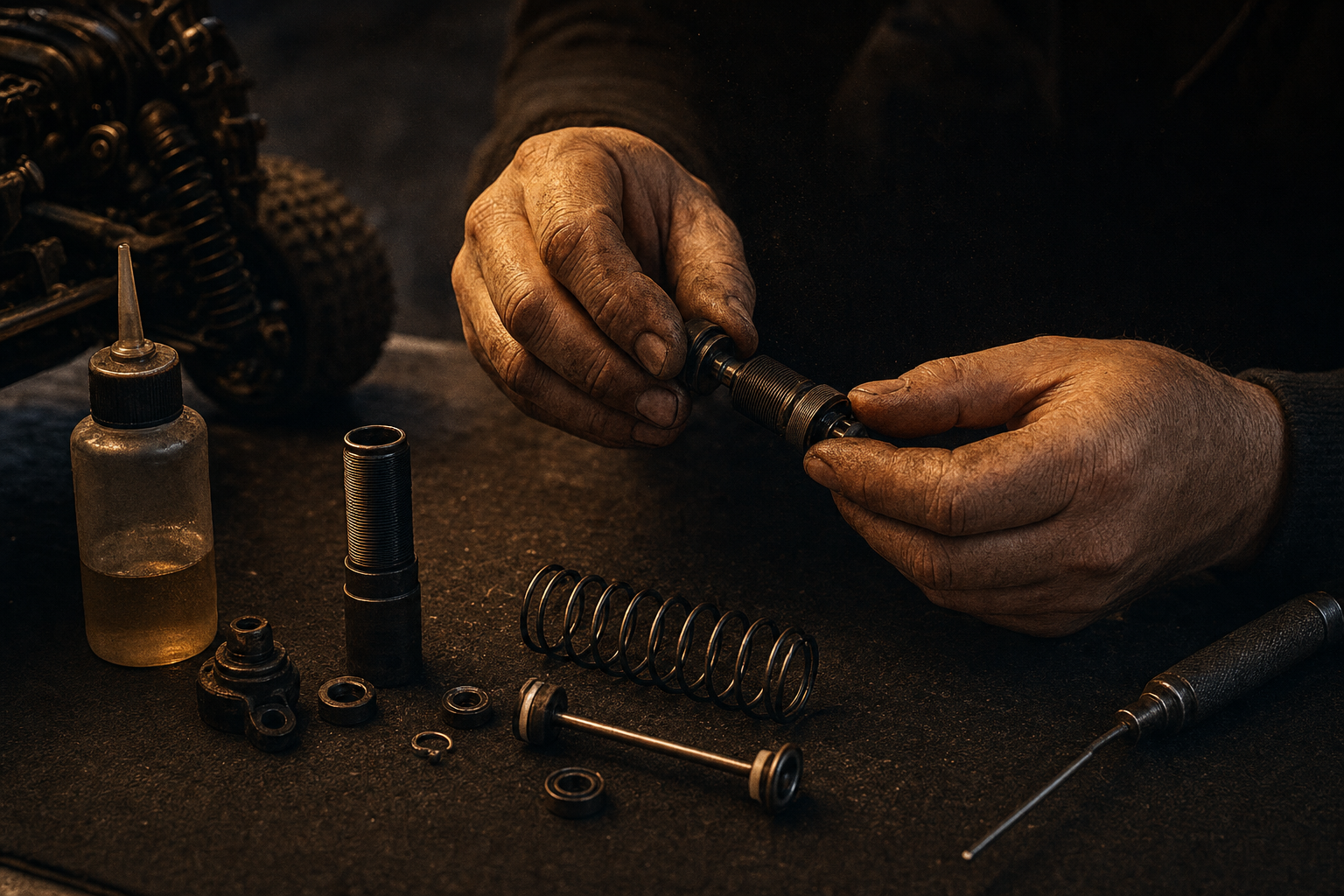
Shocks earn the tightest loop in the schedule. HPI: “Racers should check their shocks before and after each run. Any leaks mean it’s time for a rebuild. Shocks on a racing R/C car should be rebuilt or given a good look every ten or fifteen runs” (HPI Racing). A rebuild means fresh oil, a seal check, and new shock oil matched side to side — details on picking the oil itself are in shock oil, springs and ride height.
Bearings don’t get a manufacturer pack number the way diffs and shocks do — they get a condition test instead. EuroRC’s guidance: re-oil bearings that “spin smoothly but feel dry,” and replace them when “wheel play increases or rotation feels gritty after oiling” (EuroRC). Outer wheel bearings take the worst of the dirt and water and typically go first. Clean and re-oil after every session; pull, spin-check, and replace on feel at your weekend teardown.
EuroRC’s schedule calls for cleaning the drivetrain “every 2–3 runs in dusty conditions” and checking gear mesh “weekly or after impacts” (EuroRC). Reset the mesh any time you swap a pinion or spur, and check it across the full rotation of the spur, not just one tooth — the full method is in RC gear mesh and backlash. Chipped or rounded teeth mean the mesh was wrong at some point in its life, whether or not it’s wrong now.
Here’s the honest gap in the published guidance: nobody publishes a pack-count interval for dogbones, CVDs, the slipper clutch, or the servo saver the way HPI does for diffs and shocks. That’s not us being lazy — it’s what the sources actually say. Treat these as condition items you check every time you’re already in the car for something else:
At the end of the season — or the off-season, if your program has one — everything comes apart regardless of pack count. Strip the car to the tub, replace every bearing that didn’t already get swapped on feel, refresh all diff fluid, rebuild every shock with new seals, and go through every driveshaft and the slipper pads with fresh eyes. EuroRC’s diff-oil guidance fits neatly into this tier too: “for casual off-road bashing, change diff oil every two to three months”; “regular drivers should change monthly”; and “competitive racers often change before each event” (EuroRC) — a calendar-flavored backstop for the one thing on the car that ages even when it isn’t leaking.
These are general starting points from the sources cited, not a universal rulebook. Your class, surface, and how hard you drive all move these numbers. Where no published interval exists, that’s noted — check those items on condition, every time you’re already in the car.
| Component | Check | Rebuild/replace interval |
|---|---|---|
| Gear differential | Grease weeping around diff shafts | Check every 20–25 packs; open and regrease on any leak |
| Ball differential | Grittiness under load, spur held still | Check every 5 packs; rebuild when gritty |
| Shocks | Leaks, fade, dead spots | Check before/after every pack; full rebuild every 10–15 packs |
| Bearings | Grit or play by hand | Clean/re-oil every session; replace when still gritty after oiling |
| Gear mesh / pinion / spur | Chipped or rounded teeth, drivetrain noise | Check weekly or after any hard impact; reset on any gear swap |
| Driveshafts / dogbones / CVDs | Slop at the pins, bent shaft, cracked boot | No published interval — check on condition at every teardown |
| Slipper clutch | Pad glaze, drifting slip distance | No published interval — check tension and pads at every teardown |
| Servo saver | Play at ball studs, soft spring/o-ring | No published interval — check with steering linkage |
| Diff fluid freshness | Weeping, inconsistent feel run to run | Every 2–3 months casual, monthly regular, before each event competitive |
| Chassis hardware/screws | Loose or stripped fasteners | Check every session |
If any of this sounds familiar, it should. Full-size grassroots racers run the exact same logic, just with a different odometer. Our companion post on how long race car parts last shows a full-size shock getting serviced every 20–25 races, not weeks — the same shape of number as HPI’s 10–15-pack shock interval here, because a shock is a shock and oil breaks down under heat either way. And preventive maintenance for race cars makes the bigger point this whole post is built on: track usage, not the calendar, log it every time you run, and service parts before they fail instead of after. Swap “laps” for “packs” and it’s the same system. If you’re running both a full-scale car and an RC program, that’s not a coincidence — it’s one habit applied twice.
Check them before and after every pack for leaks — any leak means rebuild now. Beyond that, HPI Racing’s guide calls for a full look or rebuild every 10–15 packs even with no visible problem, because the oil and seals wear whether or not the shock is leaking yet. Rough or dusty tracks will shorten that window.
It depends which type. Gear diffs get checked for grease leaks every 20–25 packs; ball diffs get checked for grittiness roughly every 5 packs, per HPI Racing’s maintenance guide. Either way, that’s a mechanical wear check — separate from adjusting diff fluid weight for handling.
No published manufacturer interval covers dogbones, CVDs, or slipper pads the way HPI’s guide covers diffs and shocks. Check them by condition — slop, cracked boots, glazed pads — every time you’re already in the car for something else, and definitely at every off-season teardown.
Clean and re-oil after every session, per EuroRC’s maintenance guide. Only replace a bearing when it’s still gritty or has noticeable play after a proper cleaning and re-oil — bearings are a feel check, not a pack-count item.
They’re the same thing on an electric car. HPI Racing’s guide defines a “run” as running the car for one full battery pack until it’s discharged, which is exactly why counting packs run — not weeks passed — is the honest way to schedule maintenance. Nitro racers use tanks of fuel as the equivalent unit.
You can run every bit of this off a notebook and a hex driver, and plenty of racers do it exactly that way for years. The part that actually breaks down is memory — knowing, three weekends later, whether that ball diff has 4 packs on it or 14. That’s the gap RacerRX closes:
Log your next rebuild in RacerRX and you’ll actually know the pack count next time — it’s free to start.
Round out the maintenance side with RC differential tuning and shock oil, springs and ride height, and set your gear mesh right the first time with RC gear mesh and backlash. Running a full-scale car too? The same usage-based habit is behind how long race car parts last and preventive maintenance for race cars.
Hit a term you don’t know? Every one is defined in the RaceYear racing glossary.
Setup notes, maintenance logs, race-day plans, and tax tracking — all in your pocket.
Get the apps