Last reviewed: August 3, 2026 · By the RaceYear team
Short answer: RC differential tuning is done with fluid, and it’s a handling adjustment, not maintenance. Thicker diff oil ties the two outputs together for more on-power steering and smoother drive on high grip. Thinner oil lets them break apart for more off-power steering and rotation on low grip. On a 4WD, front, center and rear all interact.
Key takeaways
RC model and rule note: Settings, voltages, temperatures, fluids, gearing, tire treatments and service intervals are specific to the model, firmware, battery, motor, tire, class and venue. Use the manufacturer’s own instructions and the current event rules; menu percentages and setup directions are not necessarily comparable between brands.
Most racers treat the differential as a drivetrain part — something you rebuild when it starts making noise. It isn’t. RC differential tuning is one of the biggest single-change handling swings on the car. The catch is that it lives inside a sealed case, so nobody sees you change it and nobody remembers what’s in it.
A differential lets the wheels on either side of an axle turn at different speeds. As So Dialed puts it, “the outside wheel needs to rotate more than the inside wheel” in a corner, and the diff is what allows that without dragging a tire.
That’s the drivetrain job. The tuning job is the interesting part: how hard the diff resists that speed difference decides whether the car pushes on entry, rotates mid-corner, or spins an inside wheel off the corner. So Dialed notes the diff “is often used to tune the turning ability of the car, particularly in 4WD cars.”
Four things get called “the diff,” and only one of them is tuned with a syringe.
| Type | How it’s tuned | Where you see it | Trade-off |
|---|---|---|---|
| Gear (fluid) diff | Silicone fluid viscosity in cSt | 1/8 buggy, most modern 1/10 4WD and 2WD buggies, short course | Handles more power, “very low maintenance,” but you have to open it to change it |
| Ball diff | Tension on the diff screw | Pan cars, many 1/10 2WD kits, classic platforms like Associated’s RC10 4WD | Adjustable from outside, lighter, smoother; needs more upkeep |
| Spool / solid axle | Nothing — it’s locked | Front of most 1/10 electric touring cars | Lighter and stronger, but less steering |
| One-way | Nothing — freewheels off power | High-bite on-road and some 4WD | Big off-power steering gain, no engine braking on that axle |
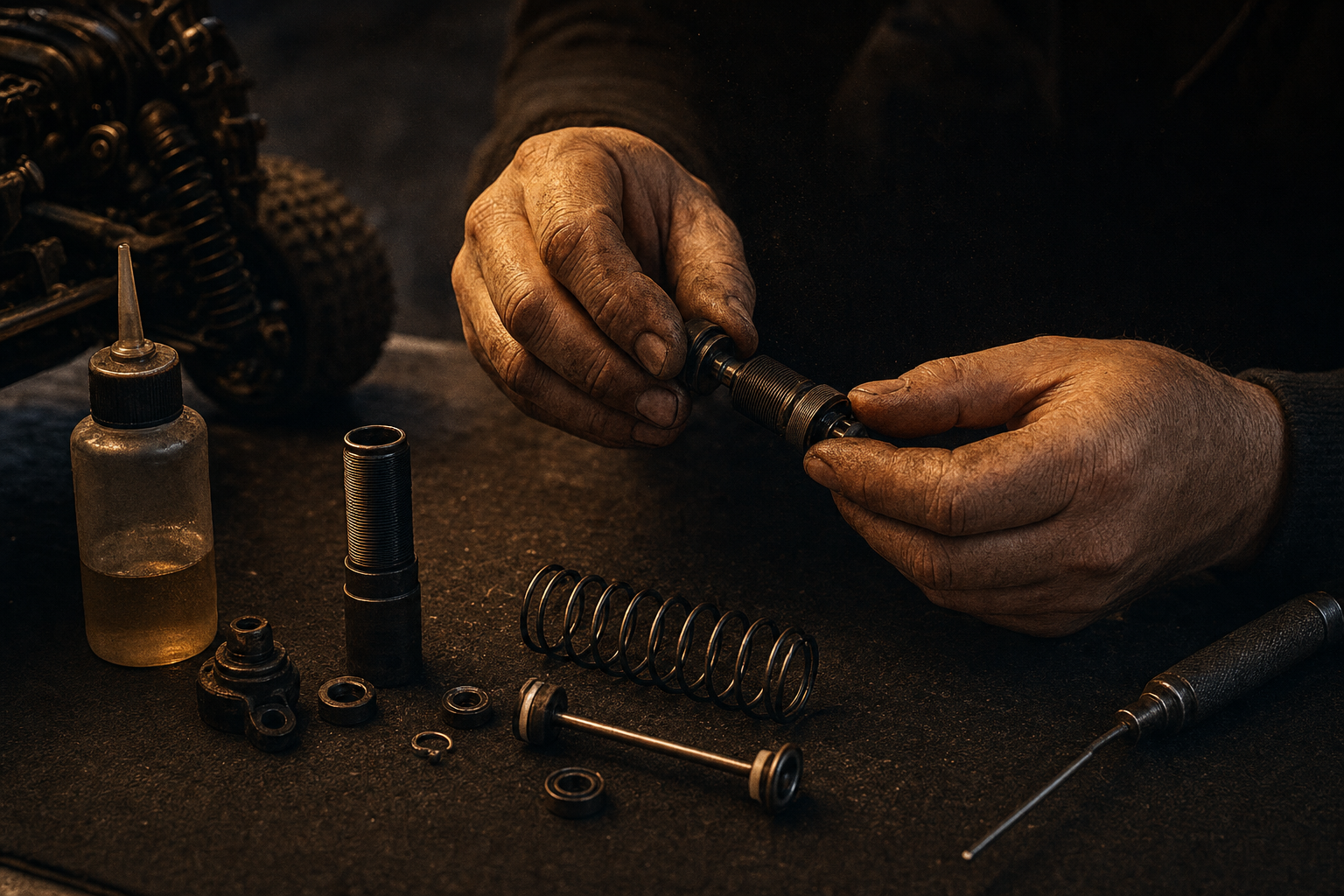
CompetitionX describes gear diffs as durable but “not externally adjustable” — changing one means pulling it apart and “adding different viscosities of fluid to limit slip.” Ball diffs “use small balls and rings to limit slip” and adjust from outside.
The spool surprises people, but on a 1/10 electric touring car it’s standard. XRAY’s T4 runs “a unique lightweight composite XRAY Front Solid Axle” up front with a gear diff in the rear, and XRAY says that rear “gear diff increases on-power steering which is needed on nearly all types of tracks” (XRAY T4). So Dialed’s fluid chart agrees: 1/10 touring front is “usually a spool — no fluid.”
Thicker fluid makes the two outputs act more alike. Thinner fluid lets them break apart. Every handling effect flows from that one sentence — but which effect you get depends on which diff you’re touching. So Dialed’s diff fluid guide breaks it down by position:
| Diff position | Thinner fluid | Thicker fluid |
|---|---|---|
| Front | More off-power steering; less on-power steering | More on-power steering; more on-power stability |
| Center | More off-power steering; more on-power rear traction | More on-power steering; more acceleration |
| Rear | More traction exiting the corner; more off-power steering | More traction in corners; more on-power steering |
Read that table twice. Thicker front fluid and thicker rear fluid both add on-power steering, but they get there differently — the front by tying the front wheels together under throttle, the rear by planting the car mid-corner. “Thicker equals more steering” is only half a rule. The broad rule that does hold: CompetitionX says “Looser diff: low-traction tracks. Tighter diff: high-traction tracks,” and notes “a tighter diff will allow more instant throttle response and greater acceleration.”
They’re one system, not three settings. Change any one and you’ve changed the balance of the whole car, because all three are fighting over the same torque. The center diff decides how much power goes forward versus back; the front and rear decide what each axle does with its share. Thicken the center and you’ve effectively sent more drive forward under throttle — which changes what the front diff is being asked to do, even though you never touched it.
Manufacturer numbers show how wide the spread is. Tekno’s EB410.2 kit manual — a 1/10 4WD buggy — specifies “Fill FRONT with #15,000 CST oil,” “#30,000 CST oil” in the center, and “Fill REAR with #10,000 CST oil.” So Dialed’s generic 1/10 4WD off-road ranges are 5,000–10,000 front, 5,000–7,000 center and 2,000–5,000 rear.
Those don’t agree, and neither is wrong. Diff fluid is chassis-, class- and surface-specific. Start from your kit sheet, not a chart you found on the internet.
Diff fluid is sold in cSt (centistokes), a real viscosity unit. So Dialed states it plainly: “Diff fluid is measured in cSt (centistokes); ‘wt’ is the shock-oil convention.” That’s good news — 5,000 cSt is 5,000 cSt.
The trouble starts when you cross over to shock oil weight, because “wt” isn’t standardized and the published conversion charts flatly disagree:
At 30 wt that’s a 25 percent disagreement between two respected sources. Neither is lying — they’re describing different brands’ house conventions. EuroRC says it out loud: “Cst and WT values aren’t directly comparable between manufacturers.”
The practical rule: “wt” is only meaningful inside one brand’s own range. Buy diff fluid by cSt, log it by cSt, and if a bottle only shows “wt,” treat any cross-brand conversion as an approximation you verify by feel — not a fact you build a setup on.
Grip level sets the direction. High-bite carpet, astro and rubbered-in clay want tighter diffs; dry-slick dirt and low-grip surfaces want looser ones.
On high grip the tires can already put the power down, so a thicker diff stops the car wasting drive and adds the on-power steering you need to get it rotated and gone. On low grip a tight diff just shoves the car straight and pushes on entry, so you go thinner and let the inside wheel give up a little.
Off-road is its own animal. CompetitionX’s rule is “In offroad, you want the diff as loose as possible without slipping,” with a clear warning sign: “If you land off a jump and hear a ‘barking’ sound, your diff is too loose and you should tighten it up slightly.”
Diff fluid isn’t your only grip lever, and it shouldn’t be your first. On a tacky night, ride height and sway bars usually move the car further and faster than opening three diffs. Reach for the diff when the problem is specifically about drive — corner exit, mid-corner rotation, or on-power push.
Fill level and seal prep are the whole game. Overfill it and you can blow the case apart; underfill it and it aerates and goes inconsistent halfway through a main. Manufacturers give you a target, and they don’t all give it the same way:
Tight enough that it never slips, and not one turn tighter. Team Associated’s RC10 4WD Team Car manual gives a repeatable method: tighten the diff bolt until the internal spring is fully compressed, then loosen it a quarter turn. Done right, “your diff should now operate smoothly with resistance as the outdrives move in opposite directions.” Re-check it early, too — Associated says “after you have driven the car once, recheck the diff settings as they may loosen up with a new differential system.”
Don’t run slip on purpose. Team Associated’s RC Handbook is blunt: “Diff slip damages the components of the diff and is inconsistent. … I never recommend running any diff slip, because that’s what a slipper clutch is for.” The handbook’s version of ball diff tuning broadly lines up with the fluid rule: “Tighter diffs help your car to put down power coming out of corners and in a straight line, while looser diffs help your car to turn corners better.”
A diff is done when it won’t hold a setting. Grinding or notchy rotation, fluid that keeps disappearing after a fresh O-ring, a ball diff that slips again a run after you set it, or oil weeping onto the spur gear all mean parts, not fluid. Change the fluid on a schedule so wear shows up in the pits instead of the main — EuroRC’s intervals are every two to three months for casual bashing, monthly for regular drivers, and “competitive racers often change before each event.”
Then the discipline that makes all of this worth anything: one diff at a time. Change the rear, run a pack, feel for corner exit. Change the center, run a pack, feel for how the car takes throttle mid-corner. Change all three and the car gets better and you’ve learned nothing, because you can’t repeat it. Write down the cSt in every position, the surface, and one honest line about how the car drove — a diff you can’t see is a setting you will absolutely forget by next weekend. For the mechanical wear side of the diff — not the fluid, the pack-count leak and grittiness checks — see RC car maintenance schedule.
Start with your kit’s setup sheet, because it’s chassis-specific. Tekno’s EB410.2 manual specifies 15,000 cSt front, 30,000 cSt center and 10,000 cSt rear. So Dialed’s generic ranges for the class are 5,000–10,000 front, 5,000–7,000 center and 2,000–5,000 rear. The spread between those tells you how much the chassis matters — build from your own kit sheet, then adjust.
It depends which diff. Per So Dialed, thicker front fluid adds on-power steering and stability, thicker rear fluid adds mid-corner traction and on-power steering, and thicker center fluid adds on-power steering and acceleration. Thinner fluid in any position adds off-power steering instead. So “thicker for steering” is true on power and backwards off power.
Not reliably across brands — and note that both published charts are shock-oil charts, not diff-fluid charts. So Dialed’s shock oil converter treats US brands as cSt divided by 10, making 30 wt equal 300 cSt. EuroRC’s shock oil chart puts 30 WT nearer 375 cSt. Both are published guides and they disagree by roughly 25 percent, because “wt” is a house convention, not a standard. Compare cSt to cSt and stay within one brand.
EuroRC suggests every two to three months for casual off-road bashing, monthly for regular drivers, and before each event for competitive racers. Change it sooner if the car’s feel drifts, if you see fluid on the outside of the case, or if the diff no longer spins with smooth, consistent resistance when you turn it by hand.
Because on high-grip on-road surfaces a locked front axle is lighter, stronger and more consistent than a diff. Most 1/10 electric touring cars run one — XRAY’s T4 uses a front solid axle with a gear diff only in the rear. So Dialed’s chart lists 1/10 touring front as “usually a spool — no fluid.” You give up some steering to get drive and durability.
You can absolutely run all of this out of a notebook. A syringe, a bottle of 7,000, and a line in a spiral pad has won plenty of mains. The problem is that diff fluid is invisible — three months later you genuinely cannot tell what’s in that case without opening it, and “I think it’s the 10k” is how a good setup gets lost.
That’s the job RacerRX is built for. Here’s how the work above maps to the app:
Log every diff change and rate the run in RacerRX so you learn what actually worked — it’s free to start at /racerrx.
While you’re at it, dial the rest of the car in with shock oil, springs and ride height, then adapt the whole package with RC setup by surface. Every change on this page is worth nothing if you cannot reproduce it next weekend — choosing an RC setup app.
Hit a term you don’t know? It’s defined in the RaceYear racing glossary.
Setup notes, maintenance logs, race-day plans, and tax tracking — all in your pocket.
Get the apps