Last reviewed: August 3, 2026 · By the RaceYear team
Short answer: Race car torque specs are the clamp-load numbers for the fasteners that hold the car together, and the critical ones live in eight systems: wheels, hubs, suspension pivots and rod ends, steering, brakes, driveline, cage tabs and seat and belt mounts, and engine internals. Torque them to the manufacturer’s spec, mark them with a paint pen, and re-check the marks weekly.
Key takeaways
Safety and service note: Use the current rulebook and the exact component, chassis, engine, fastener, hub, lubricant and safety-equipment manufacturer instructions. Generic intervals, torque values and inspection results cannot establish continued eligibility, remaining life, correct preload or fitness for service. Replace or escalate any safety-critical part after an impact, heat event, deformation, contamination or abnormal measurement, whatever the calendar says.
Every crew chief in the pits says “do a nut and bolt check” like it’s a thing everybody already knows how to do. Almost nobody says what it actually means on a race car — which fasteners, what number, how often, and how you get through fifty of them before the trailer doors close. Here’s the whole system, and none of it requires anything fancier than a paint pen and one honest wrench.
A torque spec is the wrench reading a manufacturer publishes to produce a target clamp load in one specific fastener, with one specific lubricant, on clean threads. Torque is what you put in. Clamp load — preload — is what actually holds the joint together, and it’s the thing you can’t see.
That gap is why torque is a decent tool and a lousy truth. ARP, which builds racing fasteners for a living, states plainly that “measuring the amount of stretch of a fastener has been proven to be the most accurate” method, ahead of both the torque wrench and torque-angle (ARP). You use a torque wrench anyway, because stretch gauges only work where you can reach both ends of the bolt.
Not every fastener on the car earns the same attention. The ones that matter share a single property: if they let go, the car changes direction without asking you first. That’s about eight systems, and everything else is housekeeping.
Work the car by system, not by wandering around with a wrench. This is the list that belongs on your inspection sheet:
| System | Fasteners that matter | What happens when it backs out | Realistic check interval |
|---|---|---|---|
| Wheels and studs | Lug nuts, stud shoulders, bead-lock ring bolts | Wheel walks off the studs, then shears the rest | Every wheel-off, plus after the first run |
| Hubs and axles | Spindle nuts, hub bolts, axle retainer and bearing plate bolts | Bearing loads up and cooks; hub leaves with the wheel | Weekly |
| Suspension pivots and rod ends | A-arm and trailing arm bolts, four-bar and Panhard bolts, rod end jam nuts | Geometry moves mid-corner and the hole elongates | Weekly, and after any contact |
| Steering | Rack or box mounts, tie rod jam nuts, steering shaft U-joint pinch bolts and set screws | You lose steering, which is not a figure of speech | Every race night |
| Brakes | Caliper and bracket bolts, master cylinder mounts, pedal clevis pins | Long pedal, dragging caliper, or no pedal at all | Every race night |
| Driveline | U-joint straps, yoke bolts, bellhousing, motor and trans mounts | Driveshaft on the racetrack and a bill for the loop | Weekly |
| Cage tabs, seat and belts | Seat mounts, belt mounting hardware, window net tabs, door bar attach points | The safety structure quietly stops being a structure | Weekly and before tech |
| Engine internals | Rod bolts, main caps, head bolts, rocker studs, damper bolt | A motor, on the trailer, in pieces | At assembly, not weekly |
Two of those rows deserve a word. Rod ends and jam nuts are the most-ignored fasteners on a dirt car — a jam nut that walks loose lets the rod end thread in or out, and your panhard bar length changes without anyone touching an adjuster. And the hole matters as much as the bolt. A perfectly torqued bolt in an egg-shaped tab is still slop, so look at the metal, not just the nut.
For cage tabs, seat mounts and belt hardware, the rulebook is the spec. Plenty of classes call out a minimum bolt grade, and grade is readable right on the head: in the 1/4-inch through 1-inch sizes, Grade 5 is medium carbon steel with three radial marks and 120,000 psi minimum tensile strength, while Grade 8 is medium carbon alloy with six marks and 150,000 psi, and the metric equivalents are stamped 8.8, 10.9 and 12.9 (Bolt Depot; STS Industrial). A hardware-store bolt with a blank head is not a grade at all. Get that sorted in the shop, not in the tech inspection line — our pass tech every time guide covers the rest of that conversation.
When the manufacturer doesn’t publish a number for their own fastener, ARP’s general chart is the closest thing to a default. These assume ARP Ultra-Torque on the threads and under the head or nut:
| Fastener diameter | 170,000/180,000 psi | 190,000/200,000 psi | 220,000 psi |
|---|---|---|---|
| 3/8” | 45 ft-lbs | 50 ft-lbs | 55 ft-lbs |
| 7/16” | 70 ft-lbs | 80 ft-lbs | 90 ft-lbs |
| 1/2” | 110 ft-lbs | 125 ft-lbs | 140 ft-lbs |
| 5/8” | 210 ft-lbs | 240 ft-lbs | 270 ft-lbs |
ARP’s own caveat is the important part: “The torque values represented here are intended to be for general information only, not for specific installations” (ARP). Your chassis builder’s sheet beats a generic chart every single time.
You do it in ten minutes by looking instead of wrenching. Once every critical fastener carries a paint witness mark, the weekly check becomes a visual scan, and you only pick up a wrench where a mark is broken.
The order below is the trick. Same route, same direction, every week — the route is the checklist, which is why you stop forgetting the passenger-side lower trailing arm bolt.
Anything you can’t finish tonight goes on the list for tomorrow, not into your memory. Our race day checklist has the trackside version of this same walk-around.
Torque marking means drawing a paint line across the fastener and onto the part behind it, immediately after final torque, so any rotation breaks the line. It is the single highest-leverage habit in this entire post, and the whole toolkit is one paint pen.
Racers on the Grassroots Motorsports forum have been trading this practice for years because nobody wrote it down properly. One poster with aviation background frames the purpose exactly right: “The torque seal’s job is to tell you if the fastener lost it’s mechanical grip or something else is wrong under the fastener” (Grassroots Motorsports forum). Another says the quiet part: “if the paint marks are aligned, i don’t see any reason to check torque unless it’s some kind of bolt that could conceivably stretch or something.” A third splits the difference and still puts a wrench on every critical suspension fastener between events.
The shop craft that makes it work:
Paint pens beat markers here — a Sharpie line smears off in fuel and brake cleaner, and you find out the hard way in August.
They solve two different problems, and most arguments about them happen because people think they’re alternatives. Safety wire keeps a fastener from leaving. Thread locker keeps a fastener from turning.
Safety wire is a positive locking device that prevents fasteners from falling out due to vibration, but it is explicitly “not a means of obtaining or maintaining torque, rather a safety device to prevent the disengagement” of screws, nuts, bolts, oil caps and drain cocks. It also can’t prevent fatigue failure in a bolt that was under-tensioned to begin with. It commonly runs 0.5 to 1 mm — 0.020 to 0.041 inch in the standard sizes — in stainless, gets routed so the wire pulls against the direction of removal, and it is never reusable — you cut it off and start over (Safety wire, Wikipedia).
Thread locker attacks the earlier failure: the rotation that sheds preload in the first place. Permatex publishes it by color and by fastener size:
| Threadlocker | Strength | Fastener size range | Getting it apart |
|---|---|---|---|
| Purple | Low | #2 to 1/4” | Hand tools |
| Blue | Medium | 1/4” to 3/4” | Hand tools only |
| Orange | High, removable | 1/4” to 1” | Hand tools with extra force |
| Red | High, permanent | 3/8” to 1” | Localized heat, roughly 500°F |
Most of those grades are rated from -65°F to +300°F, with a high-temperature red rated to +450°F (Permatex). That 300°F ceiling is the number that catches racers out — a blue-locked fastener bolted to a header collector or sitting behind a brake rotor is living outside its rating.
The practical rule on a race car: thread locker on anything small, threaded into aluminum, or historically prone to backing out. Safety wire on anything that must not depart the car even if it does come loose, which usually means brake caliper hardware, drain plugs and filters, plus whatever your rulebook names. On the handful of fasteners that would hurt somebody, run both, and paint-mark them anyway.
Four categories get replaced rather than re-torqued, and only one of them is obvious.
Stretched rod bolts. ARP’s rule is measurable: if a fastener measures 0.001 inch or more longer than its original length, it “has been compromised and must be replaced” (ARP). That’s the whole basis of rod bolt stretch measurement, and it’s why a stretch gauge lives in serious engine shops.
Safety wire. Cut it, bin it, run new. It’s designed to be destroyed on removal.
Anything with damaged threads or a rounded head. A fastener you had to fight to remove has already told you what it thinks of another race.
Nylon insert lock nuts — with a real disagreement attached. Published guidance does not agree here, and that’s worth knowing rather than papering over. Wikipedia’s summary of the practice records racing engineer Carroll Smith’s view that “the nylon insert is not damaged by installation and therefore they can be reused many times,” an FAA position allowing reuse if the prevailing torque is still within specification, and a U.S. Air Force requirement to replace self-locking nuts in critical areas (Nyloc nut, Wikipedia). Nyloc nuts also only hold their locking ability up to 250°F. For a race car, the field version of that prevailing-torque check is feel: if the nut spins down the thread by hand with no drag, its insert is finished. And keep them away from brakes and exhaust entirely — use an all-metal locking nut where it gets hot.
Lubricant is part of the spec, not an accessory to it. ARP is blunt about the magnitude: “Slicker lubricants may reduce the required torque by as much as 20-30% to achieve the desired preload” (ARP). Put anti-seize on a fastener carrying a dry torque spec and the same wrench click now delivers substantially more clamp load than the engineer intended.
Two more details from the same source that almost nobody does at the grassroots level. New fasteners assembled with motor oil, moly or EPL “typically require 5-7 cycles before final torquing to level out the initial friction and achieve the required preload” — meaning your first torque reading on a brand-new bolt is the least trustworthy one you’ll ever take. And threads should be cleaned with chaser taps before installation, because crud in a blind hole eats torque that never reaches the joint.
Wheel studs are the exception that trips people up. Several owner’s manuals warn against putting oil or grease on wheel studs or nuts unless specifically instructed, since lubrication changes the clamping force produced at a given torque and can lead to loosening or over-tightening (Lug nut, Wikipedia). If your stud or wheel manufacturer specifies a lubricated number, use it and use their lube. If they don’t, run them dry and clean.
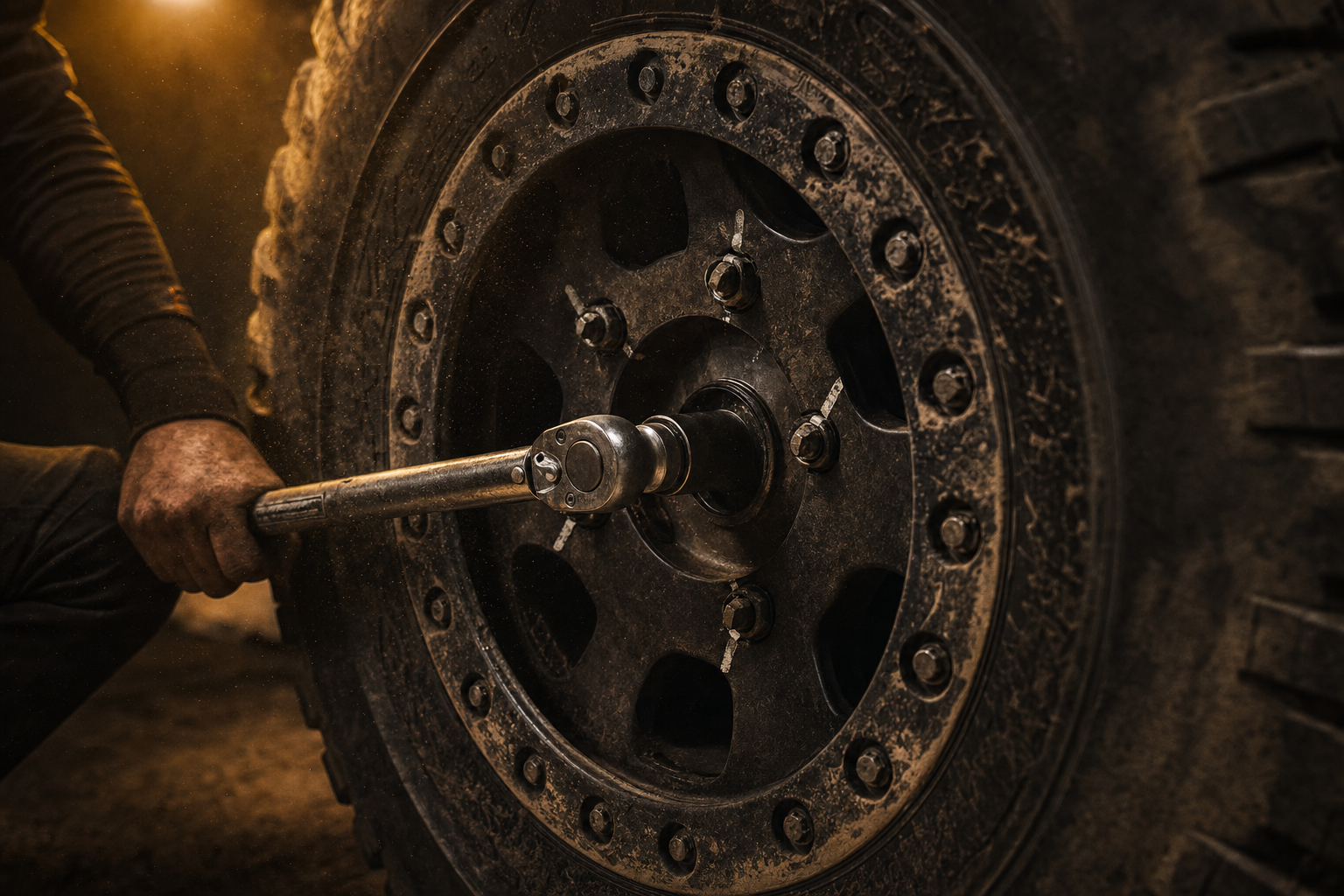
Racing wheel torque is a two-step job, not one big pull. Speedway Motors recommends “starting at 40 ft/lbs of torque for your first step to get the wheel seated properly,” then going to the final value for your lug thread size (Speedway Motors). The common racing sizes they list are 7/16”-20, 1/2”-20, 9/16”-18, 5/8”-18 and 5/8”-11 in SAE, plus 12 mm x 1.25, 12 mm x 1.50 and 14 mm x 1.50 in metric. More than one racer has stood at the trailer with the wrong socket for at least one of those.
Three rules make the difference between wheels that stay on and wheels that don’t:
On the final number itself, be careful about borrowed answers. Consumer charts summarize common passenger-car values at roughly 80 to 100 ft-lbs, and specific manufacturers publish their own — a 2023 Toyota Corolla manual calls for 76 ft-lbs, some Subaru manuals specify 58 to 72 ft-lbs (Lug nut, Wikipedia). Race cars run bigger studs, aluminum wheels, and sometimes bead-locks, so none of those numbers transfer. Use the number from your stud manufacturer and your wheel manufacturer, and if they disagree, use the lower one and check it more often.
A clicker drifts, and the published guidance on how fast disagrees. That disagreement is genuinely useful, so here’s both sides rather than an average.
ISO 6789 allows a click-type wrench ±4 percent deviation above 10 Nm and ±6 percent at or below it, and calls for recalibration “after 5000 cycles of torquing or 12 months, whichever is soonest.” The same summary notes that wrenches “can fall up to 10% out of calibration in the first year of use,” and that click types should be stored at their lowest setting (Torque wrench, Wikipedia). Racers on the Grassroots Motorsports calibration thread cite wrench manuals that specify roughly half that: recalibration every 2,500 repetitions, or about once a year for most users (Grassroots Motorsports forum). Both land on the same annual clock; they’re 2:1 apart on cycles. Take the conservative one — you’re not paying for cycles, you’re paying for wheels staying on.
What actually keeps a wrench honest in a race shop:
If a wrench gets dropped on concrete, treat it as unknown until you’ve checked it. That’s not superstition. That’s five minutes with a weight and a tape measure standing between you and a rebuild.
Most short-track teams do a full check after every race night, and a walk-around scan of the witness marks before every session. The honest answer depends on how hard the surface is on the car — a rough dirt track shakes fasteners loose faster than a smooth asphalt oval. Check everything you touched during the week, every time, no exceptions.
Sources disagree. Wikipedia’s summary of the practice notes one expert saying the nylon insert survives installation and the nut can be reused many times, that the FAA allows reuse if prevailing torque is still within specification, and that the U.S. Air Force requires replacement in critical areas. The practical rule for a race car: if it spins on by hand, it is done. Nyloc nuts also lose their grip above 250 degrees F, so keep them away from headers and brakes.
Yes. ARP says slicker lubricants can reduce the torque needed to reach a given preload by as much as 20 to 30 percent. Put anti-seize on a fastener with a dry torque spec and you will overload it at the same wrench reading. Use the number that matches the lubricant the manufacturer specified, and if you change the lubricant, you have changed the spec.
Neither replaces the other. Safety wire is a positive locking device that keeps a fastener from backing all the way out, but it is explicitly not a means of obtaining or maintaining torque. Thread locker resists the rotation that loses torque in the first place. On a fastener that will hurt somebody if it leaves the car, plenty of teams run both, plus a witness mark.
Published guidance disagrees on the cycle count. The ISO 6789 summary calls for recalibration after 5,000 torque cycles or 12 months, whichever comes first, while racers on the Grassroots Motorsports forum cite wrench manuals specifying about 2,500 repetitions or roughly once a year. Both land near the same annual clock. Wrenches can also drift up to 10 percent in their first year, so check yours against a known weight.
You can run all of this on paper. A clipboard on the wall, a paint pen in your pocket, and a route around the car that never changes will get every fastener on this page checked, and plenty of championships have been won exactly that way. The measuring was never the hard part. Remembering which bolts you re-torqued in April, which ones have backed out twice, and what still needs doing before Friday — that’s the part a clipboard loses:
Put your nut and bolt check on a schedule that actually runs in RacePrep — demo mode is free, so you can build the list tonight. Then pair it with the weekly race car maintenance checklist for the rest of the week’s work, and read when to replace rod bolts and valve springs before you decide a stretched fastener is fine for one more night. The spindle nut is a torque spec with a second job — race car wheel bearing service covers preload too.
Hit a term in here you’d have to go look up? Every one of them is defined in the RaceYear racing glossary.
Setup notes, maintenance logs, race-day plans, and tax tracking — all in your pocket.
Get the apps