Last reviewed: August 3, 2026 · By the RaceYear team
Short answer: A dirt track rain out policy is the track’s written rule for what happens to your money, your points and your night when weather stops the show. Every track sets its own completion threshold — heat races done, half the laps run, seven races in the book — and that line decides whether you get paid, get points, or get a rain check.
Key takeaways
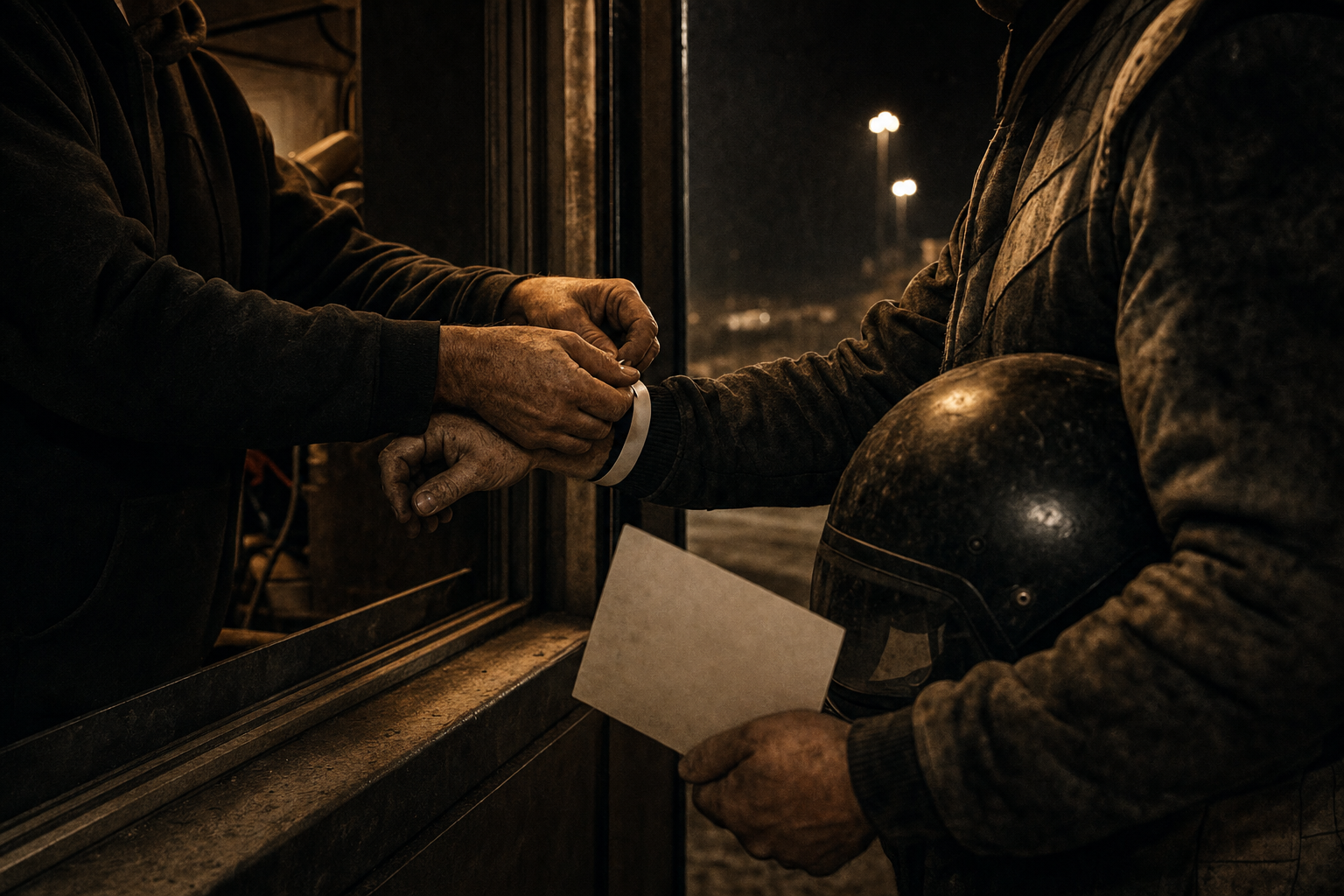
You watched the radar all afternoon. The track hadn’t posted anything, so you loaded, and you were forty minutes out when the post finally went up. Now you’re sitting in a wet pit with a wristband you already paid for, a program that may or may not get finished, and a makeup date about to land on the one weekend you’d promised to somebody else. Here’s what the rulebooks actually say — and what to do with your schedule afterward.
A dirt track rain out policy is the track’s published rule that defines when a race program counts as complete, what you get back if it doesn’t, and how the missing races get rescheduled. It is two rules stapled together: a money rule for people who bought something, and a scoring rule for people who raced.
A rainout is not simply “it rained.” It’s a specific status the track declares, and the declaration has a threshold behind it. Big O Speedway spells out the two different calls officials make: if they think “the inclement weather will pass, a rain delay is put into effect,” and if they think it won’t, “an official rain out is announced” (Big O Speedway).
The trap for racers is that almost every rain policy you’ll find on a track website is written for ticket buyers. It tells you what happens to a grandstand stub. It says nothing about your pit pass, your purse money, or your points. Those live in the rulebook, in a different document, usually a PDF nobody links from the homepage.
Nowhere near the same place. Six real rulebooks and policies checked in July 2026 use six different thresholds for the same call, and the gap between them is the single most important thing in this post.
| Track or sanctioning body | Where the threshold sits | What that means for you |
|---|---|---|
| IMCA, 2026 General Procedures | Qualifying races completed | Below that line it is not officially a rainout at all |
| Slinger Super Speedway, 2026 | More than half the laps or events run | Over half: paid and scored. Under half: no payout |
| Big O Speedway | Heat races complete | After heats, no rain check on a ticket or a pit wristband |
| Ohsweken Speedway | Seven races complete | Night deemed complete, no rain checks, no exceptions |
| All-Tech Raceway | Half the advertised laps of the feature | Race deemed complete, all sales final |
| Knoxville Raceway, 2026 rulebook | Hot laps completed in all three classes (a points rule, not a completion rule) | Points awarded only if hot laps ran |
IMCA’s language is worth memorizing because it runs backwards from what most racers assume: “A program is not considered a rainout unless qualifying races have been completed” (IMCA 2026 General Procedures). Get washed out before the heat races run and you didn’t have a rainout — you had a night that never started.
Slinger Super Speedway uses a halfway test instead: “An event rainout is defined by the number of laps or number of events. More than or less than half determines if the event is complete or rained out” (Slinger Super Speedway 2026 General Procedures). All-Tech Raceway applies the halfway idea to one race instead of the whole show: a race is complete once “half the distance of the advertised laps have been completed for that feature event” (All-Tech Raceway).
So “we got the show in” means six different things across the six rulebooks above on the same rainy Saturday. Find your track’s number before you need it.
Almost never in cash. Nearly every policy checked here converts your money into a credit, a rain check or a re-entry, and several say so in capital letters. All-Tech Raceway’s policy opens with “ALL SALES ARE FINAL AND NO CASH REFUNDS WILL BE GIVEN AT ANY TIME” (All-Tech Raceway). Ohsweken Speedway is just as blunt about its rain checks: “NO EXCEPTIONS WILL BE MADE AND NO REFUNDS WILL BE GIVEN, NO MATTER WHAT THE CIRCUMSTANCES” (Ohsweken Speedway).
The good news for racers is that pit money is usually handled, even when the policy page pretends you don’t exist.
| Track | Grandstand side | Pit side |
|---|---|---|
| Big O Speedway | No cash refunds; ticket good for one of the next two scheduled races at equal or lesser value | No cash refunds; keep the wristband, with an exception for a traveling series that will not be rescheduled |
| Ohsweken Speedway | Ticket stub is your rain check if fewer than seven races ran | Pit wristband is your rain check on the same terms |
| Slinger Super Speedway | Not addressed in the racer procedures | Pit passes kept, good only for re-entry the next time that division races |
| All-Tech Raceway | Rain check good for the next scheduled race, or the next race of the same sanctioning body | Not addressed |
| Eldora Speedway | Ticket is the rain check for the announced date; a cancelled event becomes non-expiring account credit | Not addressed |
| Toledo Speedway | Advertised rain date means tickets are good only for the makeup; a cancellation becomes credit toward another race that season | Not addressed |
Three details in that table cost people money every season. First, Big O’s pit exception — cash comes back only for “a traveling series that will not be rescheduled,” which is exactly the case where a rain check is worthless to you (Big O Speedway). Second, All-Tech’s rain check follows the sanctioning body, not just the track, and if the replacement event costs more you pay the difference. Third, Toledo Speedway draws a hard line between a postponement and a cancellation: with an advertised rain date, “tickets will be good only for the make-up date and no refunds will be issued,” but a true cancellation “can be credited to any alternative race in the current race season” (Toledo Speedway).
Eldora Speedway is the most generous version of the same idea: your ticket is your rain check for an announced date, a cancelled event becomes account credit at face value that doesn’t expire, and complimentary tickets are not valid rain checks (Eldora Speedway). Even there, the words are “NO REFUNDS OR EXCHANGES.”
One practical note that has nothing to do with the track: a rained-out tow is still a trip that happened, and if you run your racing as a business it still belongs in your records with the fuel, the gate and the miles. That’s general education and not tax advice — ask your own tax professional. Either way, budget for it, because a washed-out night is a real line item in what a season of racing costs.
That depends entirely on how far the program got before the call, and the rules are much more specific than most racers realize. Rain shortened race points are usually decided by one sentence in the rulebook, not by an official’s judgment on the night.
| When the rain came | What happens to points | Sourced example |
|---|---|---|
| Before hot laps finished | Often nothing counts at all | Knoxville awards points only if hot laps are completed in all three classes |
| After qualifying, before the feature | Program can be declared a rainout | IMCA: not a rainout unless qualifying races have been completed |
| Feature never made up | Everyone is scored the same | IMCA awards all drivers last place points |
| More than half the events run | Night pays and scores | Slinger pays completed events, then pays the rest on the average of positions in attendance |
The IMCA rule is the one that surprises people: “If feature is rained out and will not be run at later date, all drivers are to be awarded last place points” (IMCA 2026 General Procedures). Nobody gains, nobody loses, and a night you towed to becomes worth exactly the same as your worst competitor’s night.
Knoxville Raceway ties scoring to hot laps: “If the races are cancelled after the teams have arrived in the infield, points will only be awarded if hot laps are completed in all 3 classes” (Knoxville Raceway 2026 rulebook). That’s a hard line at the front of the night, and it means a track that gets one wet practice session in has already changed your points race.
Slinger’s version is the friendliest to a racer who showed up. Over half the show, drivers “are paid and given points for the completed events,” and the races that never ran are “paid on the average of the positions in attendance” (Slinger Super Speedway 2026 General Procedures). Under half, there’s no payout, and show-up points are awarded only if all practice sessions were completed. Note the fine print on show-up points: they go to all in attendance “who have registered, purchased a pit pass and signed in at the pit entry building.” Sitting in the hauler without signing in can cost you the only points on offer.
If you’re chasing a title, this is where the arithmetic gets real. A washed-out night that pays everyone last-place points quietly compresses the standings and protects whoever is leading. That’s worth thinking about before you decide whether tonight is a points night or a paycheck night — see points vs. purse for the rest of that argument.
Makeup dates land in one of three places, and only one of them is on your calendar already.
The first is bolted onto an existing race night. IMCA permits this specifically: “There are no double feature nights allowed, excluding rainout make-up features” (IMCA 2026 General Procedures). So the makeup for your washed-out feature shows up as a second feature on a night you were already going to run.
The second is the next open day. Eldora Speedway states it plainly for big events: “Rain date for the major events is always the next clear and race-able day(s)” (Eldora Speedway). That can mean Sunday. It can mean Monday. You will hear about it with very little notice.
The third is a rain date that was printed on the ticket before the season started, which is the Toledo Speedway model — an established, advertised rain date that the tickets are already good for.
| Where the makeup lands | Extra cost to you | The part that bites |
|---|---|---|
| Added to an existing night as a double feature | One tow, one gate, two features of consumables | A long night on tires you meant to save for the second race |
| The next clear and race-able day | A full second night, often on a day or two of notice | Work, family, and whoever was going to help you load |
| A pre-printed rain date | A full second night, but you had warning | It usually collides with a race you had already entered somewhere else |
Two rulebook details save arguments here. Knoxville requires that “for events in which the A-Main is rescheduled for another date, all driver changes must be pre-approved by Knoxville Raceway Officials” (Knoxville Raceway 2026 rulebook) — so if your regular driver can’t make Sunday, ask first, don’t just show up with somebody else in the seat. And Knoxville’s attendance rule reads “Teams may miss a maximum of 4 events not including rain outs, to remain in Season Points,” meaning a rainout doesn’t burn one of your allowed absences at that track. Skipping the makeup might. Check yours.
Check the track’s own Facebook page and website first, because that is literally what the rulebook tells you to do. Slinger’s 2026 General Procedures: “In the event of inclement weather prior to the opening of the pit gate, monitor the track Facebook page and/or website for updates” (Slinger Super Speedway 2026 General Procedures).
Understand that the track is not making the call on your schedule. Big O Speedway’s policy says that if the track can’t be returned to racing conditions, you’ll be “notified over the PA system that we have rained out for the evening” — the PA system, meaning after you’ve already towed in and unloaded. Track officials will fight for a race, because track prep crews can do remarkable things with a wet surface and time. The upside of that stubbornness is more racing. The downside is that the official answer usually arrives late.
So build your own routine and stop refreshing radar at the shop:
On that forecast percentage — it does not mean what most people think, and the National Weather Service says so directly. The Peachtree City office defines Probability of Precipitation as “the probability that the forecast grid/point in question will receive at least 0.01 [inches] of rain” — a probability for one point on the map, not a share of the area (NWS Peachtree City). The Paducah office gives the same 0.01-inch definition and adds where the number comes from: it is reached “by multiplying two factors: Forecaster certainty that precipitation will form or move into the area X Areal coverage of precipitation that is expected” (NWS Paducah).
The Paducah sheet is explicit that a 40 percent does not mean 40 percent of the area covered at a given time and does not mean rain 40 percent of the time. So the number carries no timing information at all, and by the Paducah formula two different weather situations — high certainty over a small area, low certainty over a wide one — produce the identical percentage. Only one of them washes out a 7pm feature. Look at the hourly panel and the radar loop, and treat the daily percentage as a headline, not a decision.
Treat the makeup as a new race that has to earn its slot, not as a debt you automatically owe. It costs a full night’s money if it lands on a fresh date, and the calendar it lands on is usually the off-week you’d budgeted for engine work, a driveway repair, or somebody’s graduation.
Work it in this order:
The deeper fix is structural. A season plan printed in March and taped to the shop wall is wrong by the second rainy weekend, and it can’t tell you that the makeup you just agreed to sits on top of something else. Build the plan somewhere it can be edited, and re-check the whole month every time a night gets called — the method is in how to plan your racing season, and understanding how a race night is structured is what lets you judge how much of the show still has to run.
Almost never in cash. Big O Speedway states no cash refunds on the pit side, with one exception for a traveling series that will not be rescheduled. Ohsweken Speedway treats your pit wristband as the rain check when the night is called before seven races. Slinger Super Speedway has you keep the pit pass, good only for re-entry the next time that division races. Read your own track’s policy before you buy.
Usually yes, if enough of the program ran. Slinger Super Speedway pays and scores completed events once more than half the laps or events are done, then pays the remaining races on the average of the positions in attendance. Knoxville Raceway awards points only if hot laps were completed in all three classes. The threshold is written in your rulebook, so find the sentence before the season starts.
Under IMCA’s 2026 general procedures, if a feature is rained out and will not be run at a later date, all drivers are awarded last place points. Nobody gains ground and nobody loses it, which quietly favors whoever is leading the standings. Other tracks handle it differently, including Slinger paying the unrun races on the average of the positions in attendance, so confirm the rule at your home track rather than assuming.
Go to the track’s own Facebook page and website first. Slinger’s rulebook tells racers to monitor exactly those two sources when weather threatens before the pit gate opens. Avoid fan groups, which spread rumors faster than decisions. Read the hourly forecast rather than the daily percentage, and set a personal deadline for loading so the choice is made calmly instead of at the last minute.
Not always, and the difference matters. Knoxville Raceway’s rulebook allows teams to miss a maximum of four events not including rain outs and still remain in season points, which means a washed-out night does not burn one of your absences there. Skipping the rescheduled makeup date, however, may count as a miss. Check the attendance language in your own rulebook before you decide.
You can absolutely run a whole season out of a paper calendar and a group text. Plenty of championships have been won that way, and the rulebook reading in this post is work no app does for you. What paper can’t do is change itself at 3:40 on a Saturday when the track posts that tonight is off and the makeup is next Sunday:
Build your season somewhere it can update itself with the RaceYear Calendar — it’s free on the web, and it beats a printout every rainy Saturday. Then tighten the plan with how to plan your racing season, and use how to find races near you to fill the hole when your home track sits one out. A rainout doesn’t just cost a night, it can cost the math — how do track championship points work covers what a makeup date does to the count.
Hit a term in here you’d have to ask about? They’re all defined in the RaceYear racing glossary.
Setup notes, maintenance logs, race-day plans, and tax tracking — all in your pocket.
Get the apps